
Which digital technology application should be added to which stage of the learning process?
Prof. Dr. Diler Aslan
March 21, 2021
Learning domains are considered when designing instruction, learning, and assessment methods. The previous blog post summarizes learning domains and their characteristics (See...). https://www.d-tek.com.tr/ogrenme-alanlari/).
To keep pace with the digital age, students need to learn to use digital technologies according to their learning domains. E-learning is inevitable in this context. The figure below summarizes digital actions according to the learning stages in the cognitive process within the learning domains. 1,2.
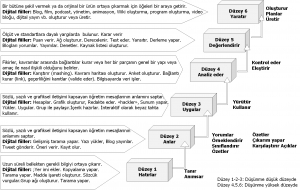
The aim of these digital activities is to enable students to learn these topics using appropriate digital technology.
As observed, at Level 1, the student should be able to search on Google, but not thousands of sites, but rather narrow down the results based on keywords to find the most accurate information and bookmark these sites for later access. They should also be able to use MS Word effectively.
The level of knowledge increases from Level 1 to Level 6. The student's thinking level develops towards thinking, understanding, applying, analyzing, and creating more. You should expect someone who submits a resume stating they are digitally competent to demonstrate Level 6 knowledge and skills when hiring them for your workplace.
Parents should learn about the characteristics of learning environments for their children's education, and business people should learn about the characteristics of e-learning modules they will use in their workplaces. This is an important factor in keeping up with the digital age.
Keywords: Learning, cognitive process, Bloom's digital classification, Bloom's digital taxonomy.
About the author: He worked in various founding and administrative positions in higher education institutions for 25 years. For the last 12 years, he served as the University Bologna Process Coordinator, Chair of the Bologna Coordination Commission, Director of the Quality Center, and Quality Coordinator. He was the founder of "problem-based active learning" in the medical education program and implemented it as a faculty member for 21 years. He was introduced to the digital world in 1972 with a Fortran II software course.
Sources:
- Amin, H. & Mirza, MS Comparative study of knowledge and use of Bloom's digital taxonomy by teachers and students in virtual and conventional universities. Asian Assoc. Open Univ. J. 15, 223–238 (2020).
- Sneed, O. Integrating Technology with Bloom's Taxonomy. Arizona State University (2016). Available at: https://teachonline.asu.edu/2016/05/integrating-technology-blooms-taxonomy/. (Accessed: 20th March 2021)
Comments (0)